Software
Should
Work
July 16-17, Columbia, Missouri
An independent conference on software reliability.
Speakers












Lightning Speakers






Recordings



Sponsors




Tickets
Early Bird
Until March 13 at 11:59pm CDT
Standard
Student discount: send proof of enrollment to [email protected] for $150 off.
Schedule
Thursday, July 16
Andrew Kelley Don't Take the Black Pill
In our modern world, it's easy to feel like things are careening out of control; that the future is happening to us while we take a back seat... and all we can do is lie down and rot.
I'm here to say, screw that! Let's apply systems thinking to the way that software and technology is integrated into our society, envision it differently, and then draw a line from here to there, identifying steps we can take right now along this trajectory.
This talk will be passionate and heartfelt, provocative, and entertaining; it will offer the audience optimism, solidarity, and purpose in the chaotic socio-technological climate that we face.
Richard Hipp Reliability Lessons From SQLite
SQLite is a C-language library that implements a self-contained, in-process relational database engine supporting full-featured SQL, an advanced query planner, and ACID transactions. By many estimates, SQLite is the most widely used software library in the world today.
Over its 26-year history, SQLite has gained a reputation as software that "just works". This talk goes over the design choices and development practices that have, at least in the opinion of the lead developer, resulted in that reputation.
Alexis King The Unreasonable Effectiveness of Constructive Data Modeling
The type systems provided by mainstream languages have grown vastly more sophisticated, but how much value does that complexity actually provide programmers in practice? I would like to make the case that it is somewhat less than one might think. While at times convenient, invariants can be captured in the type system using a small set of simple tools applied in principled fashion, and while fancy type systems may be convenient, they have misled many programmers by obscuring what is possible to model without built-in type system support. This talk aims to provide a simple shift in perspective, plus a set of concrete design principles, to make modeling invariants in types feel accessible to the working programmer without fancy language support.
Hillel Wayne How to Find Bugs in Systems That Don't Exist
Building correct distributed systems takes thinking outside the box, and the fastest way to do that is to think inside a different box. One different box is “formal methods”, the discipline of mathematically verifying software and systems. Formal methods teaches us to see a system through three different perspectives: the abstract specification behind the system, the environment it assumes, and the properties it should and shouldn’t have. Rather than gradually learning these perspectives from months of using formal methods, we will instead learn them through a forty-ish minute conference talk.
John Murray Derivations to Deployments: Practical Nix in Production
At Antithesis, we care deeply about determinism and reproducibility. This led us to heavily adopt Nix throughout the entirety of our tech stack and deployment processes. This talk will cover some of the simple but powerful abstractions we built on top of Nix and how rethinking a "traditional" deployment setup has made Antithesis more reliable and development faster.
Delaney Gillilan Put State in the Right Place, or: How I Learned to Stop Worrying and Love the Web
The web browser has never been more capable, yet modern web development often means hundreds of megabytes of dependencies, layers of abstractions, and an endless stream of security vulnerabilities. But there is another way. By leveraging the browser, embracing web standards, and putting state in the right place, we can create interactive apps that are simpler, more resilient, and built to stand the test of time. This talk explores how Datastar enables a return to web fundamentals without sacrificing performance or user experience.
Andrew Helwer How Good Are the Go & Rust Concurrency Checkers?
For concurrent and distributed systems, formal modeling languages like TLA+, P, and Quint are the gold standard for finding bugs before they appear in production. However, our field continues to evolve and now Go and Rust both have checkers that promise to provide “fearless concurrency” by validating your source code directly. How powerful are these checkers? A TLA+ user takes them for a spin.
Tommy Graves Building Docker Images Faster by Changing the Dockerfile
Container image builds are still based on an idea from 2013: a linear sequence of filesystem snapshots. The Dockerfile was a brilliant abstraction when containers were new, but it imposes constraints that make modern builds slower, less incremental, and harder to parallelize than they need to be.
In this lightning talk, I'll propose a different approach: treating image construction as a dependency graph instead of a sequence of layers. Rather than executing a Dockerfile from top to bottom, we can build container images directly from content-addressed tasks, allowing work to be cached, reused, and parallelized at a much finer granularity.
The result is the same OCI-compatible image, but produced in a way that more closely resembles how modern build systems compile software.
We'll explore why Docker image builds invalidate more work than necessary, why layer-based caching has fundamental limitations, and what a graph-native image build system could look like instead.
If you've ever wondered why a one-line change can trigger minutes of rebuilding, this talk is for you.
Erin Swenson-Healey Tightly Couple Your Client to Your Server: Type-Safe, In-Process, Full-Stack Tests
Our React tests do not stub out the backend. They do not use MSW. They do not record HTTP fixtures. They run against an in-memory instantiation of the actual server, in the same process as the React tree.
The client and server talk to each other through a TypeScript interface. In production, the React app receives an implementation of that interface that is an HTTP client which makes XHRs to the real server. In tests, that implementation is the server itself, constructed in-process and backed by a real (in-memory) SQLite database created by running our production migrations and seeded using the same helpers we use in our server-side tests. Because the interface is a TypeScript type, every call across the client/server boundary is type-checked at compile time, in production and in tests alike.
Drop the HTTP layer and the tests turn into ordinary function calls. What you give up: a thin smoke test of the HTTP boundary, and the option of writing your backend in something other than TypeScript. What you get back: full-stack tests that parallelize arbitrarily, because each one runs against its own in-memory SQLite database and shares no state with any other. There is no lifecycle to juggle across multiple stateful processes. The same setup utilities work in server-side tests and frontend tests. And there is no mocked or stubbed backend to keep in sync with the real implementation, because there is no mocked backend. I will show one test and trace it from React render to SQLite and back.
Trevor Settles I Just Wanted a Non-Blurry Screen Magnifier
Accessibility is commonly bolted on instead of thought through at the beginning. This reduces usability for many users. This is a case study of that story for screen magnifiers.
The current state of screen magnifiers is subpar and will essentially never change. Each pixel gets magnified and looks blurry at 5x+ zoom. The (seemingly) reasonable choice of representing the screen as a grid of pixels has unintended consequences.
I'll walk you through my story of how I ran into this, tried to solve it, and ultimately found that it's not worth solving.
It is a hard problem to think of all possible ways software could be used. In the case of screen magnifiers, they will always be a bit blurry. Here, the root solution is designing software in a way that a screen magnifier isn't even needed in the first place.
Visibility into how others use software can help to make sure it is usable for more people. The earlier we know about what those problems are, the better we can make it.
Jayaprabhakar Kadarkarai Why You Should Create Your Own DSLs in the AI Era
Most AI applications have moved beyond chat interfaces and now rely on structured outputs, function calling, and agent workflows. While these approaches work well initially, they often become difficult to scale as prompts grow, workflows become more complex, and reliability requirements increase.
In this talk, I'll share lessons learned building AI-powered developer tools and explain why we started replacing ad-hoc schemas and function calls with purpose-built domain-specific languages (DSLs). I'll show how DSLs can make AI systems more reliable, easier to validate, cheaper to run, and easier for both humans and models to reason about.
We'll look at concrete examples of where structured outputs break down, how a DSL can encode intent more effectively, and practical guidelines for deciding when a custom language is worth the investment.
Tilman Roeder Be Careful When Improving Performance
We have two systems at $work that are getting more loaded over time and started to fall over handling queries from clients.
Counterintuitively, when we improved throughput and latency the systems started suffering from worse performance problems.
In the lightning talk, I’ll explore why this can happen, how to spot accidental load-shedding in a service, and what to watch out for when trying to make sense of misleading metrics.
Tom Wheeler How Temporal Achieves Durable Execution
Temporal is an open source platform used by thousands of companies to make applications more reliable. One of its key features is Durable Execution: crash-proof execution that gives applications automatic state persistence and the ability to run reliably for any length of time. In this lightning talk, you’ll see what happens when a Temporal application crashes, and how it automatically recovers and resumes without losing state or unnecessarily repeating work that has already completed.
Friday, July 17
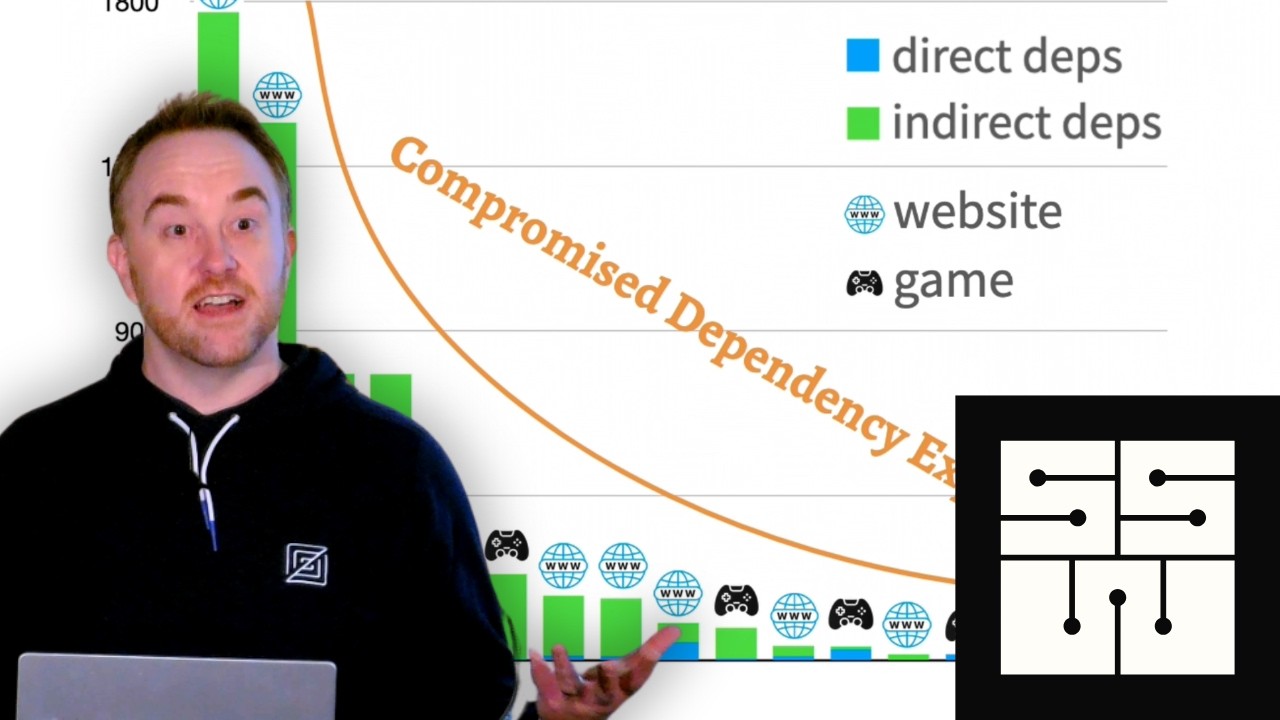
Richard Feldman Dependency Cultures
Some software depends on no third-party code. Some depends on a ton of it. Whether these dependencies are brought in at runtime, at build time, forked, "vendored," included directly or indirectly, and how carefully they were vetted before being brought on, can have a huge impact on how well the software works - and how vulnerable it is to exploits.
Despite this, there's no consensus on the best way to think about dependencies. It's been a source of major disagreement among programmers for decades, and different communities have developed their own norms around dependencies. Some of these differences are technical, but many are cultural: practices we follow mostly because our peers do it that way, and straying from the herd carries risk.
This talk explores a wide spectrum of differing cultural practices around dependencies, as well as the benefits and drawbacks of each. Come see how others are doing it, what's worked and what hasn't, and what new ideas you might be able to take back to your own practice!
Marianne Bellotti System Daydreams and Logarithmic Colored Glasses
Why do memory leaks, cloud costs, technical debt, and outages so often catch experienced engineers by surprise? Could the answer be the way your brain has evolved to think about numbers? This talk explores how our intuitive number sense governs how we perceive and reason about rates of change and misjudge growth, scale, and accumulation—and how understanding that bias can make us better at building and operating complex systems.
Ray Myers Code Worth Writing
When we try to definitively answer "Is code for people or AI?" it creates a paralysis where we cannot define progress. Let's embrace that plurality. There will be code worth writing, and some not even worth reading. Even as these boundaries shift, we can find leverage.
Code has a third audience that all others depend on: Algorithms. Programs that reason about programs. They power our compilers, editors, static analyzers, and even coding agents. These tools are so successful within their scope that we often forget they're there. Now is the time to remember.
Imagine being able to prove that a critical requirement holds for all possible inputs, or that your worst class of security vulnerabilities is ruled out by construction. We can do this with formal foundations, bringing the next generation of verification techniques out of niche research and into common industry practice. We will build certainty into an uncertain future.
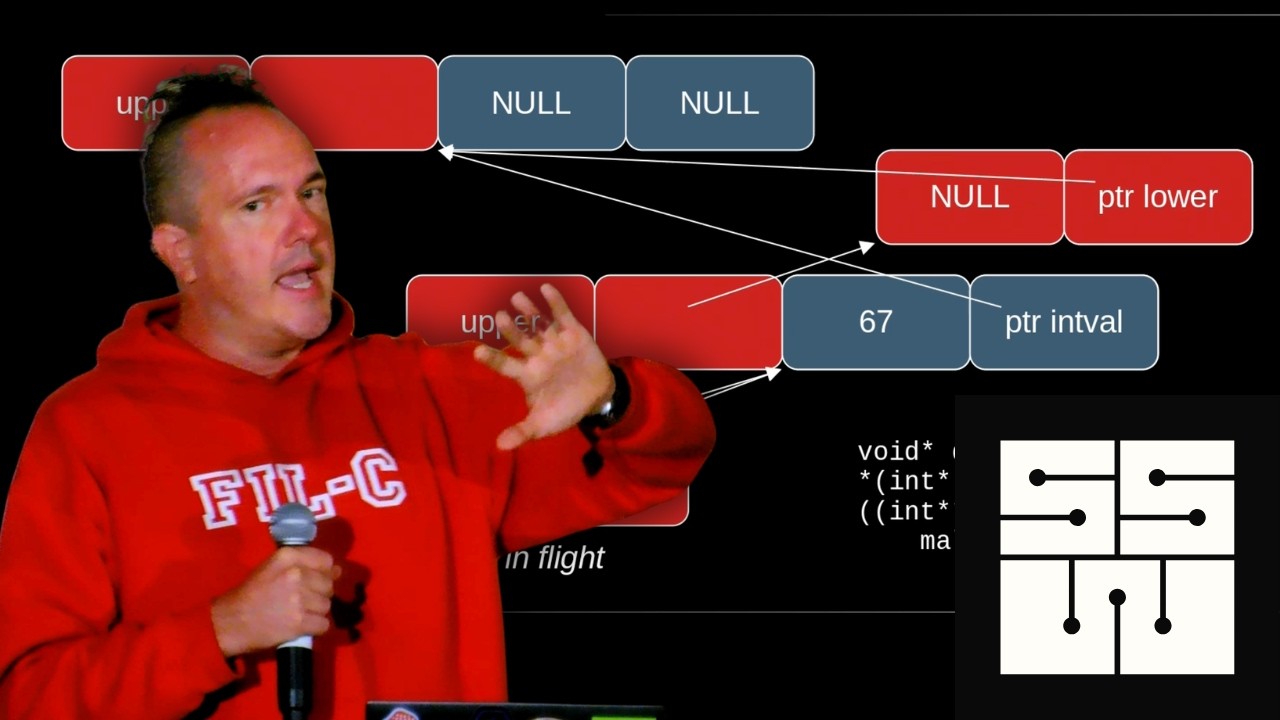
Filip Pizlo Fil-C: Garbage In, Memory Safety Out!
Conventional wisdom has it that C and C++ are not memory safe programming languages. A simple bug in one part of a C program can be used to achieve remote code execution even in the presence of sophisticated mitigations. The problem is severe enough to create great pressure on programmers to rewrite their code from C and C++ to other languages that are safer. This talk challenges the conventional wisdom by describing an implementation of C and C++ that achieves the same level of protection against memory safety exploits as even the safest languages. I will go into the details of Fil-C's compiler, language runtime, and some of the corpus of software that has been ported to it.
Lorin Hochstein Saturation: How Your Software Will Fail at Scale
Even in the ethereal world of software, everything has a limit. And, once that limit is reached, very bad things can happen. In this talk, we will explore the problem of saturation: when a software system runs into one of these limits. We'll see a sampling of the many different kinds of system overload, how our systems are always potentially at risk of saturation no matter how well designed they are, and what we can do to prepare for the day when a system in our charge has been pushed beyond what it can normally handle.
Carson Gross AI & The University
The last year has seen the dramatic emergence of widespread AI-based coding practices. This has shaken many developers' faith in computer programming both as a career and as a vocation. It has also shaken University departments, especially in computer science: students are using AI to complete assignments, take tests, and, as one would expect with students, to avoid as much work as possible.
In this talk, Carson, who teaches computer science at Montana State University, will consider the position of the University in the age of AI tools: the good, the bad, and the ugly. Perhaps surprisingly, he will present an optimistic take on how the University can, with some changes, provide an excellent platform for preparing students for a fruitful career in technology.
Order subject to change
Venue


SSW will be held at
voco The Tiger Hotel,
23 S 8th St, Columbia, MO 65201. Book a room with our
group rate
(sold out), or consider staying at
The Broadway, a 6 minute walk from the venue.
Travel
Fly into the Columbia Regional Airport (COU), or for more options, consider landing in St. Louis (STL) and taking a shuttle or rental car.
While in COMO
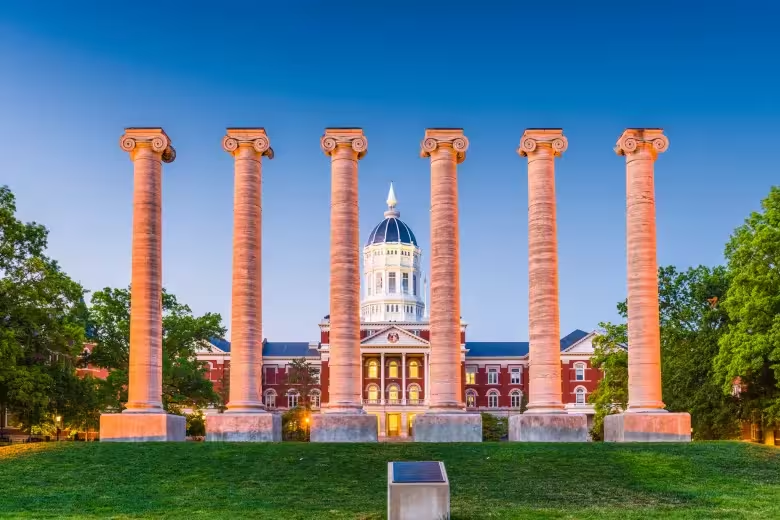

Visit Mizzou's campus or explore our extensive rail trail network.
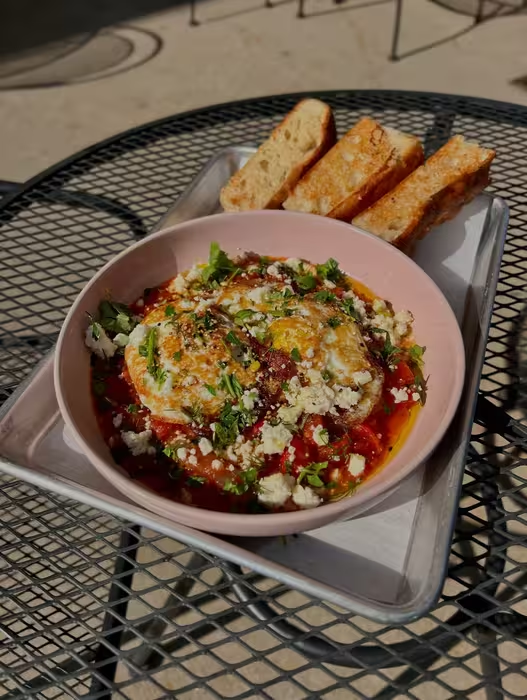
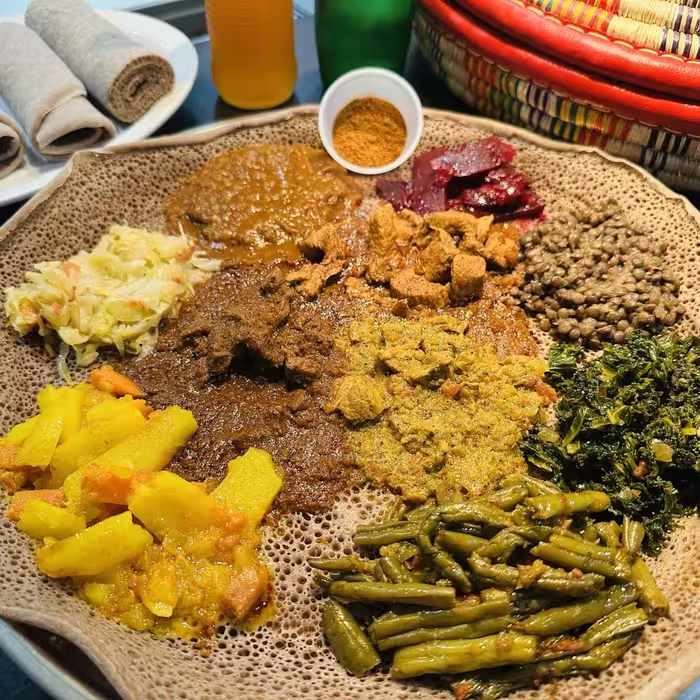
Isaac's Food Guide